
macular degeneration
Macular Degeneration (MD) is the name given to a group of degenerative diseases of the retina that cause progressive, painless loss of central vision, affecting the ability to see fine detail, drive, read and recognise faces.
Although there is no cure for MD, there are treatment options that can slow down its progression, depending on the stage and type of the disease. The earlier the disease is detected, the more vision you are likely to retain.
Age-related macular degeneration, or AMD, is the most common cause of vision loss in people over the age of 65. In its more advanced stages, AMD will cause patients to have a very noticeable decrease in their ability to see sharply or use focused vision, which is the type of vision required for reading or watching television.
AMD can be diagnosed by looking at the back of the eye with an ophthalmoscope. Before you notice any changes, our Optometrist is able to detect both pigment clusters within the centre of the retina and drusen, which are yellow whitish residues which can be found along the retina. In the later stages new blood vessels can be seen. By means of fluorescent angiography these new blood vessels can be depicted most clearly.
At this time there is no known cure for macular degeneration. In some cases, macular degeneration may be active and then slow down considerably, or even stop progressing for an extended period. There are ways to slow macular degeneration, depending on the type and the degree of the condition. These range from nutritional intervention, injection or laser surgery of the blood vessels.
For more information, please visit, Macular Disease Foundation Australia.
FAQs
-
You can have early signs of macular disease without knowing it. However, when symptoms do appear, they can include:
difficulty with reading or any other activity which requires detailed central vision (despite wearing appropriate glasses)
distortion, where straight lines may appear wavy or bent.
problems distinguishing faces.
dark patches in the central vision.
-
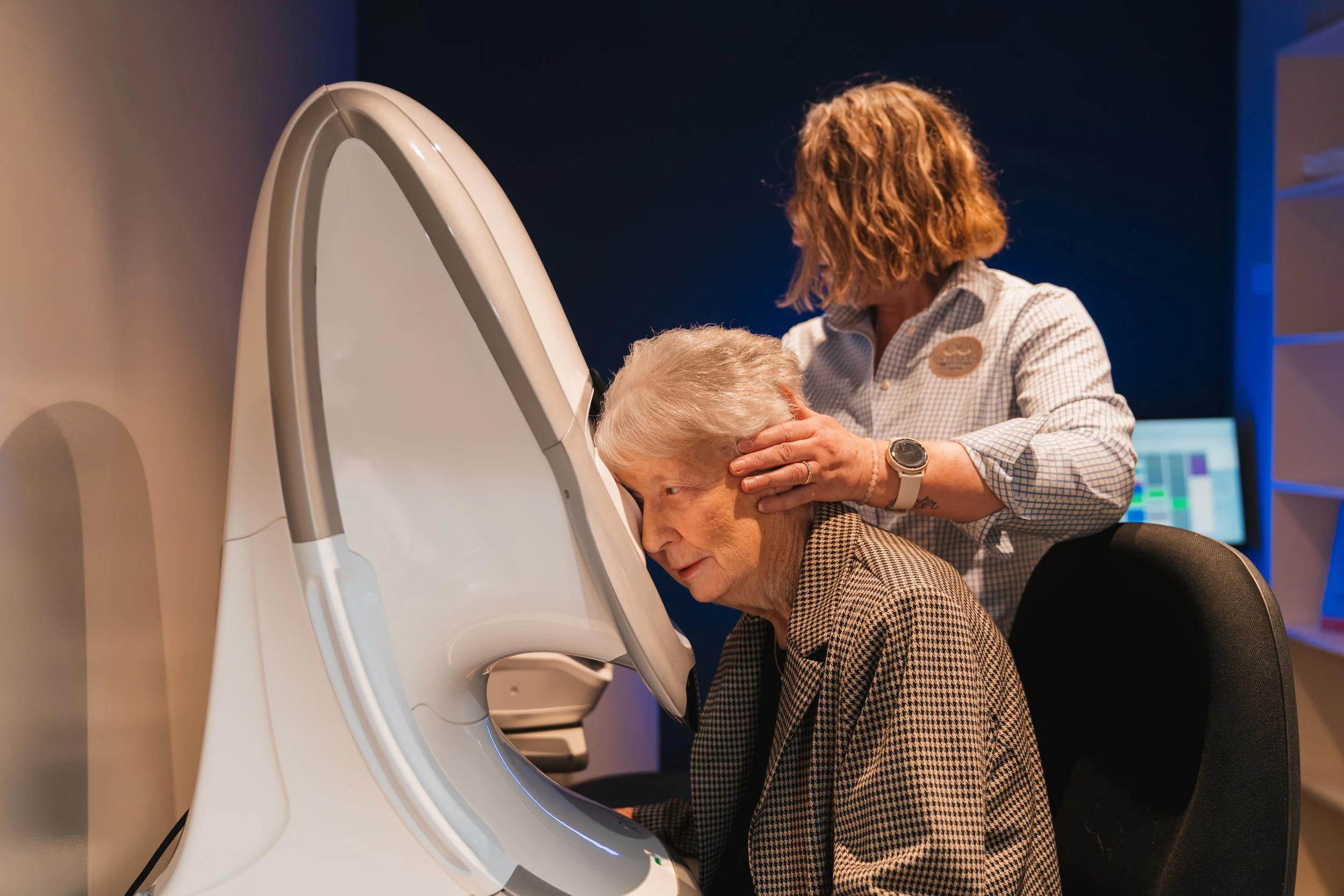
As part of your eye examination your optometrist will check the macular at the back of the eye. The Optometrist may also want to put eye-drops in your eyes when checking for AMD.
It is also recommended you have a photograph (Optos) and scan (OCT) of your macular. These tests analysis the nerve fibres of the macular for any early signs of disease. The Optometrist will assess these and have as a comparison at your next eye examination.
-
The major risk for developing AMD is age, with one in seven people over 50 years affected. Smoking is the major controllable risk factor with smokers having twice the risk of developing AMD. You should have an eye exam which checks for the signs and symptoms of AMD if you:
are older than 50 years
are a smoker
have hypertension or cardiovascular disease
have a family history of AMD
have a history of UV exposure